
How to Lose Weight Without Losing Muscle: 7 Steps to Replace Fat with Muscle

Updated: 7 days ago
If you want to lose fat and tone your body, but you don’t want to lose muscle at the same time?
This is for you.
Let me start by showing you a picture below just for illustration purposes. It’s the same woman, same exact weight, but different body fat percentage.
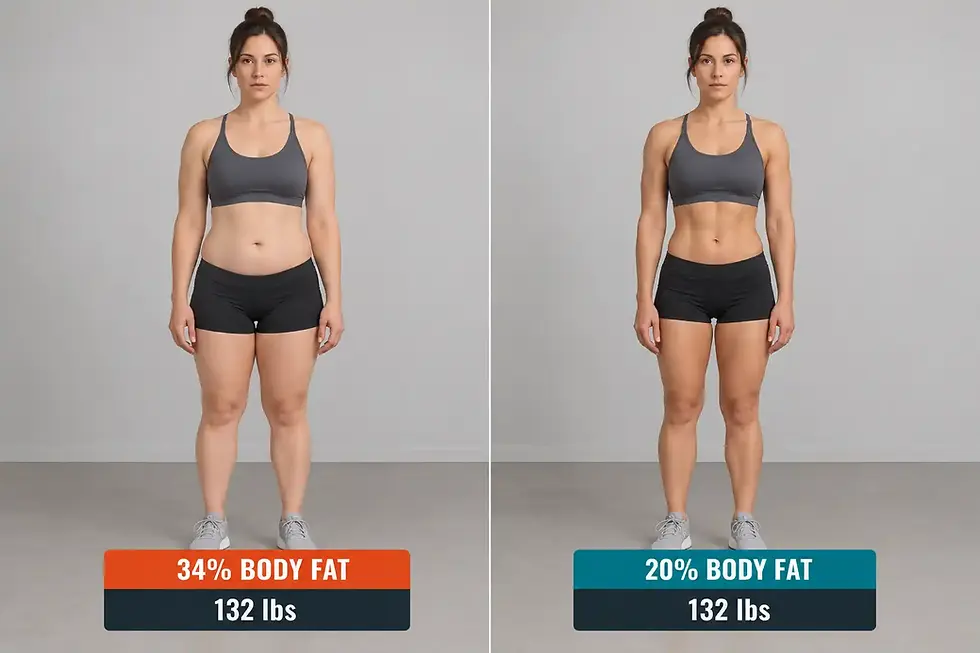
At our gym I see this all the time.
People come in looking for help with losing weight and getting toned.
We get on the InBody machine for a body fat assessment, and we then see that their body fat percentage is much higher than they thought.
Half the people we test are clinically obese and they don’t even look it!
We call this “skinny fat.” High fat, low muscle.
Obesity is when you are over 32% bodyfat as a female, and 26% bodyfat as a male according to The American Council on Exercise (ACE).
A lot of the times when people lose weight, a big portion of that weight comes from muscle.
They're shocked and confused because the scale went down, but they still don't see the toned muscles they were hoping for.
Here's what I want you to understand:
Your goal shouldn't just be to lose weight. It should be to lose body fat while keeping the muscle that gives your body shape and definition.
I'm going to show you 7 things you can start doing asap to make that happen.
How many calories you need, workouts, everything to get you started.
Ready?
STEP 1: Lift Weights to Lose Fat Without Losing Muscle
Here's the definition of being "TONE":
Building muscle mass while reducing body fat so that your muscles become visible.
By definition, you have to actually build muscle which requires you to do some sort of resistance training (weight training) that will stimulate your muscles to grow.
Here's a picture of our client Michael on his 30 lb weight loss journey.

Notice the difference between the middle picture and the picture on the far right?
In those two versions he weighs roughly the same!
But you can clearly see that the version on the right has more lean, tone mass than the middle version.
He went through a period where he looked "normal" (middle picture), yet his body fat percentage was still pretty high. This was his "skinny fat" period.
What propelled him forward was a solid nutrition program [see step 4] and consistent weight training.
If You Diet Without Weights? This Could Be Your Biggest Problem.
Dr. Mike Israetel says it best:
“Most people want leaner. They don't just want smaller. And when you lose weight without doing resistance training of some kind, then your probability of losing muscle as well as fat is almost 100%.”
And that's the last thing we want.
Muscle is what gives your body that lean, sculpted appearance. It also helps support your metabolism and joints..
When you lift weights, you're basically telling your body, "Hey, we're using these muscles. We need to keep them!"
My favorite researcher Dr. Andrew Huberman of Huberman Labs podcast says it like this:
“If you're somebody who's kind of averse to resistance training, you are going to lose muscle size and strength, your metabolism will drop.”

If you want to look toner and leaner, you gotta lift.
And no, lifting weights three times a week isn't going to accidentally turn you into a professional bodybuilder. I promise.
What to do: Start with two to three full-body resistance-training workouts per week.
Focus on basic movements like squats, rows, presses, and hip hinges. You don't need a complicated program. You need consistency.
Need a workout?
Simply go to Chatgpt and type "Please give me 2 to 3 full body weight training workouts for a ___year old who is looking to lose weight and get tone."
If you need help with accountability and a plan so you actually do the workout, let's chat.
STEP 2: Eat Enough Protein to Preserve Your Muscle During Weight Loss
If you're trying to lose body fat, protein is going to be a requirement, not a suggestion.
Why?
Muscles are both made of protein and built from the amino acids supplied by protein the protein in your diet.
Without enough of it? You're starving your muscles.
Hence, you won't get tone.
And when you're in a calorie deficit, getting enough protein becomes an even more vital part of the process.
Protein also helps keep you full longer, which makes it easier to avoid snacking throughout the day.
How much protein should you eat?
“Most people are severely under-eating protein and do not know it."
Here’s a simple formula you can use to calculate your daily target.
According to the International Society of Sports Nutrition, this is what you need:
Goal body weight × 0.8 = daily protein target in grams.
Let's say you're currently 170 pounds and want to get down to 150.
150 × 0.8 = 120 grams of protein per day.
Depending on your training and individual needs, you may benefit from more protein, sometimes closer to one gram per pound of goal body weight.
150 × 1 = 150 grams of protein per day.
But here's something I've learned after training thousands of people.
PLEASE don't make this complicated.
If you're currently not eating enough protein, start with one simple change.
What to do: Try adding another 30 grams of protein to your daily diet.
That could be a protein shake, Greek yogurt, chicken, eggs, or whatever works for you.
I've seen this one simple strategy work miracles for clients who are busy and struggling to get enough protein.
STEP 3: Create a Calorie Deficit Without Losing Muscle
Here's something I wish more people understood.
You can't consistently lose body fat without creating a calorie deficit.
That simply means you're eating fewer calories than your body uses.
OVER. TIME.
Not all at once! This is why many people fail.
Too extreme too soon.
How do we create a balanced approach that will keep up sane and satiated?
Calorie Calculator
How many calories should you eat in a day to get tone?
This is a super simple formula:
Goal body weight × 12 = goal daily calories.
For someone with a goal weight of 150 pounds:
150 × 12 = 1,800 calories per day.
Now, this isn't a magic formula.
Your actual calorie needs depend on your age, height, current weight, activity level, and other factors.
For most people, 1,800 calories will create a deficit. For others, it won't.
If you want quicker fat loss, multiply by 10 instead:
Goal body weight × 10 = estimated daily calories.
How do you know if it’s working? You see the scale numbers going down and you aren’t constantly hungry.
What to do: Try tracking your food for seven days using an app like MyFitnessPal or MacroFactor.
Not forever. Just for a week.
And if tracking food sounds like a nightmare, don't worry!
I'll show you a much simpler method in Step 5.
STEP 4: Use The ONE Method™ to Make Eating For Fat Loss Easier
Over my 20 years as a trainer, I've tried just about everything with my clients.
Detailed meal plans. Calorie tracking. Macro calculations. Grocery lists.
You name it.
But I noticed something frustrating.
I'd give people these beautiful, perfectly calculated meal plans based on 200 questions, and they'd follow them for like, two days.
Two days!
By Wednesday, they were completely overwhelmed.
By Thursday, the meal plan was tossed in the garbage while they were eating their kid’s chicken nuggets over the kitchen sink.
And I remember thinking, "What the heck is going on? I've given you everything you need. Why aren't you following it?!"
Then one day out of pure frustration, I told a client:
"Okay, forget the entire meal plan. Just pick ONE meal from it and eat that meal every day for the next week."
And you know what happened?
They actually did it.
So the following week, we added another meal.
Then another small habit.
Pretty soon, the person who couldn't follow a meal plan for two days was consistently eating better week after week and losing 1 lb of fat per week!
That's when it clicked.
The problem wasn't that people needed more information. I was giving them too much, too soon.
That's how I started developing what I call The ONE Method™.
And it's super simple.
Eat the "PERFECT MEAL" For Fat Loss
I call it the "perfect meal" because my clients were consistently losing fat with this one strategy.
One day I said, “Dang… this is the perfect meal for fat loss!” It just stuck.
Grab a medium-sized plate and use your hand to estimate your portions.
Protein: One palm-sized serving of chicken, fish, lean beef, eggs, or another protein-rich food.
Complex carbohydrates: One palm-sized serving of rice, sweet potatoes, quinoa, potatoes, or whole-grain pasta.
Vegetables: One palm-sized serving or more of broccoli, green beans, squash, spinach, or whatever vegetables you enjoy.
Healthy fats: One or two thumb-sized servings of avocado, olive oil, nuts, or another healthy fat.
That's your Perfect Meal.
No food scale.
No complicated calculations.
Just your hand and a plate.
And the best part? You don't need a degree in nutrition to figure out a palm size amount of chicken breast.
For busy people who need a simple way to start eating better, this is incredibly useful.
How the ONE METHOD™ Works for Fat Loss
Week 1: Eat one Perfect Meal every day. Keep the rest of your diet the same for now.
Week 2: Add a second Perfect Meal each day.
Week 3: Add a protein-rich snack if needed to help reach your protein goal.
Week 4: Work toward having most of your meals follow the Perfect Meal approach.
That's it!
And if you're struggling with a particular week, repeat it before moving forward.
The ONE Method™ works when you're traveling, eating at restaurants, or grabbing something quick between meetings.
The goal isn't to eat perfectly. It's to develop eating habits you can maintain for the rest of your life.
STEP 5: Your 4-Week Plan to Lose Fat & Gain Muscle
If you're wondering how to put everything together, here's where I'd start.
Week | Nutrition | Exercise |
1 | One Perfect Meal daily | Two strength workouts and a few short walks |
2 | Two Perfect Meals daily | Continue lifting and gradually increase brisk walking, or do a full cardio session |
3 | Add a protein-rich snack if needed | Work toward 2–3 strength sessions and regular cardio |
4 | Three Perfect Meals daily | Maintain a routine you can repeat every week |
You just have to start.
Frequently asked questions about losing fat and gaining muscle.
Can you lose fat and build muscle at the same time?
Yes! This is called body recomposition. It's especially possible for beginners, people returning to strength training, and individuals with higher body fat percentages.
The key is combining resistance training, sufficient protein, and appropriate calorie intake.
How much protein should I eat to lose fat without losing muscle?
A practical starting target is approximately 0.8–1 gram of protein per pound of goal body weight daily, although individual needs vary.
For example, someone with a goal weight of 150 pounds could aim for approximately 120–150 grams of protein per day.
Can I lose fat without lifting weights?
Yes, but you may also lose muscle during the process.
Resistance training helps preserve muscle while you're losing weight, which is why I recommend lifting weights two to three times per week.
How long does it take to lose weight and see muscle definition?
Some people notice changes within four to eight weeks, but results vary depending on starting body composition, nutrition, training consistency, and genetics.
Building noticeable muscle definition often takes longer.
Is cardio or weight training better for losing fat?
Both have benefits.
Cardio increases energy expenditure and improves cardiovascular fitness, while weight training helps preserve muscle during weight loss.
Combining both is generally a better approach than relying exclusively on either one.
Want accountability with your weight loss plan?
This is exactly what our weight loss and toning private personal training is for. If you're in the Melbourne, Suntree, Viera area in Bravard county, reach out to me directly and I'll give you some support.
You got a mission and a purpose my friend.
I hope this helps!
Peter Feysa
STATE360 Founder & CEO
Written by Peter Feysa, Founder of STATE360™ Fitness & Performance. Peter has over 20 years of personal training experience, working with more than 3,000 clients across 25,000+ one-on-one training sessions.
This article is for general educational purposes. Nutrition and exercise recommendations should be adjusted for individual health needs and circumstances.
